
Agentic Customer Service: Complete Guide for AI-Driven CX (2026)
Quick Answer: What is Agentic Customer Service?

Agentic customer service is an AI-driven support model where autonomous AI agents can perceive, reason, act, and learn to resolve customer issues independently. Unlike traditional automation, it enables proactive, goal-oriented interactions across multiple channels — reducing human intervention while improving operational efficiency, response time, and customer satisfaction.


TL;DR

  • Agentic customer service uses autonomous AI agents to handle customer interactions end to end

  • Moves contact centres from reactive support to proactive problem-solving

  • Combines AI and human agents for complex scenarios — AI handles volume, humans handle complexity

  • Improves scalability, reduces costs, and boosts CSAT

  • Ideal for omnichannel contact centres handling high-volume or time-sensitive enquiries


Agentic customer service represents the next evolution of AI-powered support, where intelligent agents independently manage customer interactions from start to finish. These systems use technologies like natural language processing, large language models, and multi-agent orchestration to understand intent, make decisions, and execute actions across enterprise systems.

In a contact centre environment, agentic AI can automatically resolve tickets, escalate complex issues, personalise responses using customer data, and even anticipate problems before a customer initiates contact. This reduces operational costs, improves response times, and allows human agents to focus on higher-value interactions where judgement and empathy matter most.

This guide explores what agentic customer service is, how agentic AI systems work across four stages, where they deliver the most impact, and how contact centres can implement them to elevate customer experience for the AI era.


Agentic Customer Service vs Traditional Customer Support

Reactive Automation vs Autonomous AI Agents

Traditional customer support automation is built on rules. A customer submits a service request, the system follows a script. There is no understanding of context, no capacity to adapt mid-conversation, and no ability to act across systems without a human directing each step.

Autonomous AI agents are fundamentally different. Rather than following a predetermined path, an agentic AI agent is given a goal — resolve this ticket, collect this payment, confirm this appointment — and determines how to achieve it using the relevant data and tools available. The distinction matters:


Traditional Automation

Agentic AI

Approach

Rule-based, scripted responses

Goal-driven, contextual understanding

Workflows

Limited, requires exact inputs

Complex workflows handled dynamically

Scalability

Fixed capacity

Elastic — scales without additional staffing

Learning

Static

Continuously learns from every interaction

Human involvement

Required for most decisions

Minimal human intervention for routine tasks

Implementing agentic customer service provides a shift from reactive, scripted interactions to autonomous, goal-driven problem solving. AI agents can autonomously analyse conversations, resolve tickets, and intelligently escalate issues when necessary — enhancing the efficiency of customer service operations at scale.

Advanced agentic AI systems can also detect potential problems and notify the customer — or fix issues — before the customer initiates contact. This proactive capability is what separates agentic AI from conventional chatbots and marks the shift from reactive tools to proactive partners that take initiative.

Human-Led vs AI-Augmented Support Teams

The move to agentic AI does not mean removing people from customer service. It means restructuring what people spend their time on. In a human-led model, support agents handle everything — high-value and low-value interactions alike. In an AI-augmented model, agentic systems absorb the volume work — FAQs, status updates, payment collection, bookings, new tickets — so human teams can focus exclusively on complex, sensitive, or high-stakes conversations.

AI agents can automate repetitive tasks such as service ticket creation, allowing businesses to allocate human efforts more effectively. AI-driven systems can handle growing customer inquiries without additional staffing or infrastructural costs, providing genuine scalability as enquiry volumes increase.

The result is lower operational costs, faster resolution, and happier customers — because every customer interaction is handled at the right level of intelligence, with the right resource.

“The most significant opportunity in agentic AI is not replacing human agents — it is enabling human agents to operate at a level of strategic value they have never been able to reach before.”


How Agentic AI Works in Customer Service (Perceive, Reason, Act, Learn)

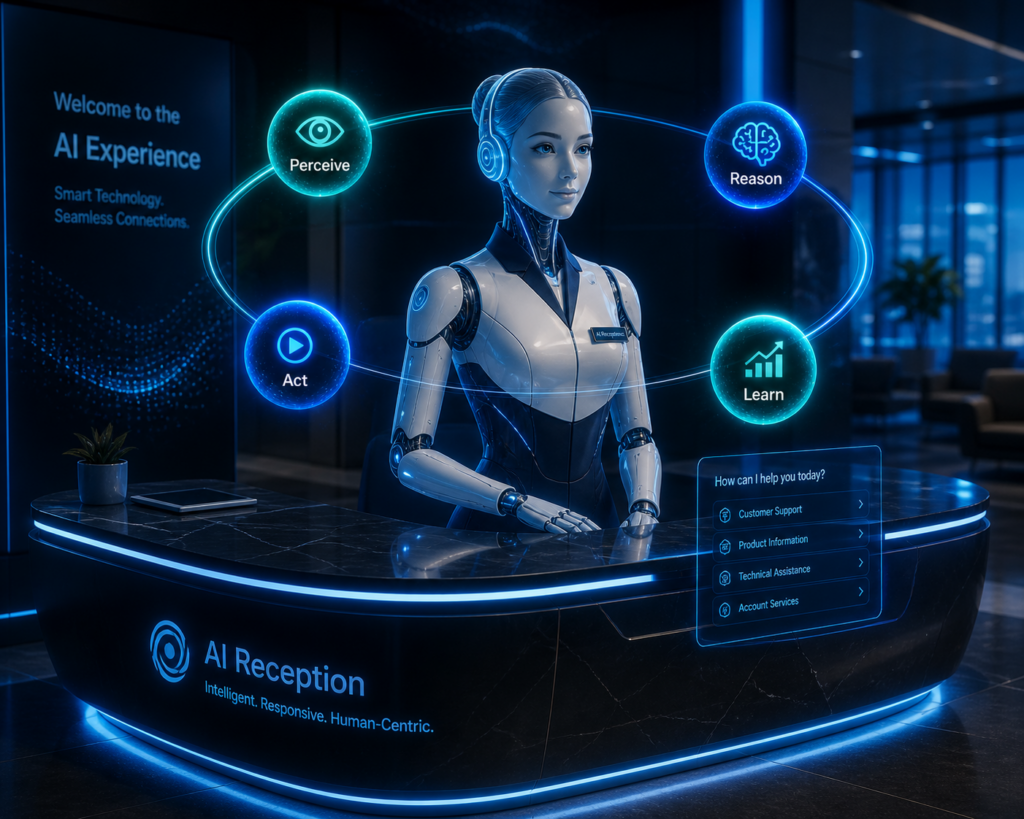
Agentic AI systems operate through a structured pathway that includes four stages: perceive, reason, act, and learn — integrating advanced AI technologies at each step to deliver consistent, scalable, and personalised support.

Perceive — Understanding Customer Intent

Before an AI agent can resolve a customer issue, it must understand what the customer actually needs. This goes well beyond keyword matching. Agentic AI uses natural language processing and advanced speech analytics to analyse customer inquiries, detect customer sentiment, and pull relevant information from connected data sources — CRM records, account history, open tickets, inventory levels, and more.

IPscape’s AI SCAPE platform powers this perception layer in real time with:

  • Sentiment and Emotion Analysis — detects customer issues by analysing tone, stress, and pacing, highlighting trends in customer sentiment before they escalate into complaints

  • Automated Quality Assurance — replaces manual review by automatically analysing 100% of conversations to gauge sentiment and compliance, eliminating the sampling limitations of traditional QA

  • Compliance Monitoring — helps manage regulatory compliance (including RG271) by generating complaint risk scores and monitoring for mandatory disclosure phrasing across every call

  • AI-Powered Summarisation — transcribes conversations and uses AI to summarise interactions, posting them directly into CRM customer files so context is never lost

  • Key Phrase Detection — identifies specific keywords and phrases to track trends, identify common customer issues, and monitor support agent performance at scale

This perception layer is what enables AI agents to assist customers in the way a skilled human agent would — understanding intent from natural, unstructured conversation rather than waiting for a structured command.

Reason — Decision-Making with AI Models

Once the AI agent understands customer intent, it reasons through the best course of action. This is where large language models and the model context protocol play a central role — the AI model evaluates context, determines the appropriate response pathway, and decides whether to resolve the issue autonomously or escalate to a human agent.

In multi-agent setups, multiple AI agents collaborate, each with specific roles — searching knowledge bases, making decisions, escalating issues — forming a dynamic network that mimics human workflows. This is how agentic AI systems handle complex tasks that would otherwise require multiple handoffs between support agents, each time forcing the customer to repeat themselves.

IPscape’s AI SCAPE platform supports this reasoning layer with a suite of pre-built use cases that can be configured without custom development:

  • AI Receptionist — answers, triages, and routes calls to the right department with appointment-setting capability

  • Customer Support — enables 24/7 support, creates tickets, defines priority, and escalates to a human with a warm transfer when needed

  • Self-Service FAQ — provides guidance and how-to responses, reducing first-contact volume for common enquiries

  • Sales Lead Generation — engages prospects, qualifies opportunities, and routes high-intent leads to the sales team

  • Appointment Confirmation — proactively reaches out to confirm attendance or reschedule, reducing no-shows without any manual outreach

  • Payment Collection — contacts customers to collect payment or identify hardship, and escalates when required (covered in detail in the use cases section below)

AI SCAPE also includes real-time assistance features for live human agents — surfacing knowledge base information, providing coaching alerts mid-call, and automating administrative tasks so support agents can stay focused on the conversation rather than the system.

Act — Executing Tasks Across Systems

Agentic AI does not just make decisions — it takes action. AI agents act across enterprise systems: resolving customer inquiries, updating CRM records, triggering workflows, sending communications via SMS or email, raising tickets in Jira, and completing complex tasks end to end with minimal human intervention.

A practical example of AI agents in action: a customer calls about an outstanding invoice. The AI agent receives the call, verifies the customer’s identity, retrieves the relevant account data, communicates the outstanding balance and due date, and presents payment options. If the customer pays in full, the system confirms payment, notifies the finance team, and updates the CRM — automatically. If the customer cannot pay, the agent offers an instalment plan or detects hardship and executes a warm transfer to a human agent, simultaneously sending a payment link via SMS and updating the CRM record with a full interaction summary.

Autonomous agents can resolve complex issues end to end in real time, eliminating wait times and the need for repeated handoffs. And because AI SCAPE is compatible with existing telephony infrastructure, businesses can enable agentic AI capabilities without replacing their current contact centre platform.

Learn — Continuous Improvement

Agentic AI systems do not stay static. They continuously learn from customer interactions, customer feedback, and outcome data — improving accuracy, resolution rates, and personalised recommendations over time. AI agents are capable of holding memory from one day to the next, allowing them to engage in dynamic communications and provide personalised customer care based on previous interactions.

IPscape’s AI SCAPE reporting suite provides analytics around the effectiveness of each AI agent, including:

  • CSAT scores — measuring customer satisfaction at the individual interaction level

  • Intent resolution rate — the percentage of customer issues the AI agent resolved without human escalation

  • Abandonment rate — how many calls or conversations ended without resolution, and at which point in the workflow

  • Sentiment trends — aggregated customer sentiment data to surface systemic issues before they affect churn or NPS

These AI-driven insights close the loop between deployment and optimisation — enabling teams to continuously refine agent behaviour and identify where human efforts remain most valuable.


Transform Your Contact Centre with Agentic AI

IPscape’s AI SCAPE platform delivers agentic customer service across voice, chat, email, and emerging channels — with deep integrations into Salesforce, HubSpot, Zendesk, and Microsoft Dynamics. Whether your goal is to automate routine tasks, reduce operational costs, or elevate customer engagement, AI SCAPE works alongside your existing telephony with warm transfer capability built in.

Platform capabilities:

  • Omnichannel customer engagement across voice, chat, email, and SMS

  • AI-powered routing, escalation, and automation with warm transfer to human agents

  • Conversational AI with NLP, sentiment detection, and speech analytics

  • CRM and UC integrations — Salesforce, HubSpot, Zendesk, Microsoft Dynamics, and open APIs

  • Real-time analytics and AI-driven insights across every customer interaction

  • Compatible with your existing telephony — no rip-and-replace required

Explore AI SCAPE →


Pricing and Budget Analysis

Cost Reduction Through Automation

Businesses can lower operational expenses by automating routine interactions and reducing the need for large support teams. AI-driven systems can handle growing customer inquiries without additional staffing or infrastructural costs — providing genuine scalability as demand increases.

Automating routine tasks is projected to deliver a 30% reduction in operational costs by 2029. For contact centres managing thousands of interactions per month, the impact compounds quickly: lower cost per interaction, reduced after-call work, and faster resolution without additional headcount.

Key areas where agentic AI reduces costs:

  • Reduced staffing requirements for repetitive tasks — AI agents handle FAQs, data capture, appointment management, and payment collection without human involvement

  • Lower cost per interaction — agentic AI handles high-volume, low-complexity interactions at a fraction of the cost of a human agent

  • Reduced training overhead — AI agents can be updated with new knowledge instantly, rather than requiring repeated training cycles for human agents

ROI of Agentic Customer Service

The return on agentic AI investment compounds across three dimensions:

Faster resolution times. Autonomous agents can resolve complex issues end to end in real time, eliminating wait times and the need for repeated handoffs. Customers get answers faster. Support teams handle more, with less.

Increased customer satisfaction. Agentic AI enhances CSAT by providing timely and accurate resolution of service requests. AI agents provide 24/7 availability, allowing customers to receive personalised support at any time — across multiple languages and locations — without the constraints of human shift patterns.

Scalable support without infrastructure growth. As enquiry volumes grow, agentic AI scales elastically. There is no need to hire, train, and manage additional headcount to absorb increased demand — the system absorbs it without additional cost.


Management and Workflow Features in Agentic Systems

Collaboration Between AI and Human Agents

Effective agentic customer service is not AI replacing humans — it is AI and humans operating as a coordinated team, each doing what they do best.

AI agents handle routine tasks: FAQs, payment reminders, appointment confirmation, ticket creation, status updates, and identity verification. Human agents handle complex issues: escalated complaints, sensitive financial conversations, high-value sales enquiries, and any situation requiring discretion or empathy that an AI model cannot reliably replicate.

The warm transfer capability in AI SCAPE is what makes this handoff seamless. When an AI agent determines that a conversation requires a human, it does not drop the customer into a queue with no context. It transfers the call to a human agent while providing a verbal summary of the interaction — so the customer never has to repeat themselves, and the human agent can pick up exactly where the AI left off.

By automating routine tasks, agentic AI allows human agents to focus on more complex and strategic customer interactions — enhancing the overall customer experience and the job satisfaction of the support team.

Integration Ecosystems

Agentic AI systems deliver their full value when they are deeply connected to the systems of record a business already relies on. Isolated AI tools that cannot read or write to enterprise systems are limited to answering questions — they cannot take action.

IPscape’s AI SCAPE platform integrates across:

  • CRM systems — HubSpot, Salesforce, Microsoft Dynamics, Zendesk — to read customer history, update records, and log interactions automatically

  • Ticketing and project management — Jira integration allows the AI agent to raise a new ticket, reference an existing ticket, update the ticket status, and complete a warm transfer to a human agent — all within a single customer interaction

  • Communication systems — Outlook, Google Mail, and SMS for outbound notifications, payment links, confirmations, and appointment reminders

  • Financial systems — Xero, Google Sheets, and Excel for payment tracking and accounts receivable management

  • Knowledge bases and external tools — allowing agents to surface relevant information in real time, answer questions accurately, and complete tasks that span multiple systems

This breadth of integration is what enables enabling AI agents to complete complex tasks end to end — not just handle the conversation, but resolve the underlying issue.


Real-World Use Cases of Agentic Customer Service

📞 AI Payment Collection

What it is: AI SCAPE’s Payment Collection workflow is an out-of-the-box AI voice solution that automates outbound payment reminder and debt collection calls. It proactively engages customers, verifies identity, communicates outstanding balances, and collects payments or commitments — all while updating your CRM and notifying your finance team in real time.

“AI SCAPE automates payment reminders, captures commitments, and updates your systems — so you get paid faster.”

Ideal use cases: Finance and accounts receivable teams, subscription businesses, utilities and telecom providers, lending and financial services, and any business managing overdue payments.

How it works:

  1. System identifies overdue accounts (more than 30 days outstanding) from the connected CRM or payment system

  2. AI initiates an outbound call to the customer

  3. Customer identity is verified — DOB, full name, postcode or address — before any sensitive information is shared

  4. If not verified, the call ends with no disclosure

  5. If verified, the AI communicates the outstanding balance and due date

  6. The customer responds:

    • If paid — AI confirms payment, notifies the finance team via email, updates the CRM, and ends the call

    • If not paid — AI offers options: pay in full, set up an instalment plan, or flag hardship

  7. Final actions based on outcome:

    • Pay in full or instalment: SMS payment link sent, email confirmation, CRM updated

    • Hardship detected: warm transfer to a human agent, SMS payment link sent, CRM updated with interaction summary

Key benefits:

  • Automated payment reminders at scale — no manual outreach required

  • Faster collections and improved cash flow

  • Secure identity verification before any sensitive information is disclosed

  • Multiple payment pathways — full payment, instalment plan, or hardship escalation

  • Zero manual tracking — CRM is updated automatically at every stage

  • Fraud detection built into the verification layer

Supported integrations: HubSpot, Salesforce, Xero, Excel, Google Sheets (CRM); Outlook, Google Mail, SMS (communications)


Additional Use Cases Across Industries

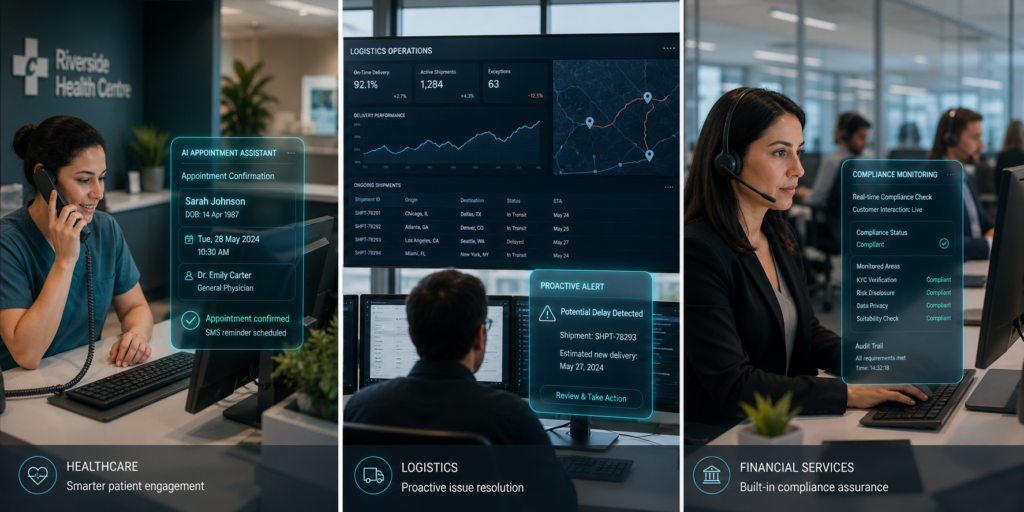
Healthcare — Proactive Appointment Management Agentic AI enhances customer engagement in healthcare by providing real-time, 24/7 conversational support where timely information is essential. AI agents can confirm appointments, send reminders, manage rescheduling, and triage inbound enquiries — reducing administrative load on clinical reception teams and improving patient experience.

Logistics — Proactive Delay Management Agentic AI can monitor shipping data and weather conditions in real time, anticipate delays, and proactively notify customers or reroute shipments before the customer needs to chase. This moves the contact centre from a reactive complaints handler to a proactive customer partner.

Financial Services — Compliance-Led Support In regulated industries, agentic AI supports human teams by monitoring every interaction for compliance — generating complaint risk scores, flagging mandatory disclosure gaps, and logging a complete interaction record for audit purposes. AI agents handle routine enquiries while human agents focus on complex cases requiring regulatory judgement.


Decision Framework: Is Agentic Customer Service Right for Your Business?

Not every contact centre is at the same stage of readiness. Use this framework to assess fit:

Business Profile

Fit

Notes

High-volume support teams (500+ interactions/month)

Strong fit

Automation delivers immediate cost and efficiency gains

Omnichannel environments (voice + digital)

High impact

Consistent AI-powered customer engagement across every channel

Regulated industries (financial services, healthcare, utilities)

Strong fit with governance layer

Compliance monitoring built into AI SCAPE by design

Businesses with complex CRM and ticketing integrations

Strong fit

AI SCAPE connects to Salesforce, HubSpot, Zendesk, Jira, and more

Small teams with mostly human-judgment decisions

Lower priority

Focus on foundation tools first; introduce AI for specific high-volume workflows

Businesses with no CRM or system of record

Not yet ready

Agentic AI requires connected data sources to act — establish data foundations first

“Agentic AI is not a replacement for strategy — it is an amplifier of it. Businesses that deploy agentic AI on top of clear workflows and clean data see compounding returns. Businesses that deploy it hoping it will fix broken processes are disappointed.”

If your business has clear, repeatable customer workflows, connected enterprise systems, and a support team spending significant time on routine tasks — agentic customer service will deliver measurable ROI. Explore how IPscape’s AI SCAPE platform applies to your contact centre.


Frequently Asked Questions — Agentic Customer Service

What is agentic customer service?

Agentic customer service is a support model where autonomous AI agents handle customer interactions independently — perceiving intent, reasoning through the appropriate response, taking action across connected systems, and learning from outcomes over time. It differs from traditional automation in that the AI agent pursues a goal rather than following a fixed script, enabling it to resolve complex issues end to end without constant human oversight.

How is agentic AI different from traditional chatbots?

Traditional chatbots are rule-based. They follow predetermined decision trees and can only respond to inputs they have been explicitly programmed to handle. Agentic AI systems use large language models, natural language processing, and multi-agent orchestration to understand intent, reason dynamically, and act across enterprise systems. An agentic AI can raise a Jira ticket, update a CRM record, send an SMS, and complete a warm transfer to a human agent — all within a single customer interaction. A traditional chatbot cannot.

Can agentic AI replace human agents?

Not entirely — and that is not the goal. Agentic AI is designed to handle routine tasks, repetitive interactions, and high-volume enquiries autonomously, so human agents can focus on complex issues that require empathy, judgement, and strategic thinking. The most effective contact centres use AI and human agents together: AI for scale and consistency, humans for complexity and relationship management. AI agents can provide 24/7 availability across multiple languages and locations — capabilities human agents cannot match alone.

What are the benefits of agentic customer service?

The primary benefits are: reduced operational costs (projected 30% reduction by 2029), improved response times, higher CSAT scores, 24/7 availability, scalability without additional headcount, and the ability to handle complex workflows across multiple channels with minimal human intervention. Agentic AI also generates AI-driven insights from every interaction — customer sentiment, intent resolution rates, compliance signals — that improve over time.

How do AI agents handle complex customer issues?

In multi-agent setups, AI agents collaborate — each with specific roles such as searching knowledge bases, making decisions, and escalating issues — forming a network that mimics human workflows. When an issue exceeds the AI agent’s configured parameters, it executes a warm transfer to a human agent, providing a verbal summary of the interaction so the customer does not need to repeat themselves. The AI agent updates all relevant systems simultaneously, so the human picks up with full context.

Is agentic customer service secure and compliant?

Yes, when implemented correctly. IPscape’s AI SCAPE platform includes identity verification built into call workflows (DOB, full name, postcode) and compliance monitoring that flags regulatory risks in real time. For regulated industries including financial services and healthcare, AI SCAPE supports RG271 compliance monitoring and generates complaint risk scores across 100% of interactions — something manual QA processes cannot achieve at scale. All interaction data is logged and written back to connected CRM systems for audit purposes.

What industries benefit most from agentic AI?

Industries with high interaction volumes, repetitive workflows, and regulatory compliance requirements see the strongest returns: financial services and lending, healthcare and medical administration, utilities and telecommunications, debt collection and accounts receivable, logistics and fulfilment, and any business operating multi-site or multi-channel customer service operations. Read how agentic AI is transforming Australian contact centres across industries.

How do you implement agentic customer service?

Implementation typically follows four steps: (1) identify the highest-volume, most repetitive workflows in your contact centre — these are your first AI automation candidates; (2) connect your CRM and communication systems to the agentic AI platform; (3) configure and test pre-built agent workflows before going live; (4) monitor performance using CSAT, intent resolution rate, and abandonment data, and refine continuously. IPscape’s AI SCAPE platform is designed for rapid deployment — compatible with existing telephony and configurable without custom development. See how AI SCAPE works for your business.


Get Started with AI-Powered Customer Service

Agentic customer service is no longer a future capability — it is available now, and contact centres that deploy it are reducing costs, improving customer satisfaction, and scaling support without scaling headcount.

IPscape’s AI SCAPE platform gives growth-oriented organisations the tools to elevate customer experience for the AI era: autonomous AI agents that perceive, reason, act, and learn — across voice, chat, email, and every channel your customers use.

Ready to see it in action? Book a demo with the IPscape team →


Related reading: